By: Ramadan Ilazi
Few issues in Kosovo generate stronger reactions than the question of Serbian-language education. It is considered by the US and the EU as a red line Kosovo government should not cross with respect to pushing for integration of the Kosovo Serbs. It is a highly sensitive issue to say the least. However, a recent survey with 500 Kosovo Albanian respondents, conducted by NGO CASA, suggests that public opinion is considerably more nuanced than the political discourse surrounding this issue. The findings challenge several assumptions that have long shaped how we talk about Serbian-language education in Kosovo. Most importantly, they suggest that the main obstacle or challenge to integration may not be public resistance or even legal ambiguity, but lack of information or awareness and even, what we can say political imagination.
In Kosovo we have two parallel education systems. One operates under Kosovo’s institutions and legal framework. The other is financed and governed by Serbia and functions largely outside Kosovo’s educational system. In many municipalities, schools following the two curricula exist side by side, sometimes even in the same buildings, but with virtually no institutional cooperation.
This reality is often presented as permanent, almost natural, but it is neither.
What is particularly striking and very important to note from the survey is that Kosovo Albanians do not reject Serbian-language education in the country. On the contrary, almost 89% of respondents agree that Kosovo Serbian pupils should have the right to be educated in their mother tongue. This should fundamentally change how the issue is framed.
So, the debate is not about language rights. The public has largely settled that question, as noted above.
The real debate concerns institutional authority.
A large majority of Kosovo Albanian respondents accept Serbian-language education, Serbian-produced textbooks under certain conditions, and teachers from Serbia provided their qualifications are recognised and they hold valid work permits. What they reject is the idea of educational institutions operating entirely outside Kosovo’s legal and regulatory framework.
This distinction is important to note and matters because it shows a gap between political rhetoric and actual public attitudes.
For years, discussions about Serbian-language education have often been framed as a clash between protecting rights of non-majority communities and asserting state sovereignty. The survey suggests that most Kosovo Albanians do not see these goals as contradictory. They believe Serbian community should preserve their language and educational identity, while educational institutions simultaneously operate within Kosovo’s legal order.
In many respects, that position is already reflected in Kosovo’s legislation.
Kosovo’s Constitution and subsequent laws (such as Law No. 03/L-068 on Education in the Municipalities of the Republic of Kosovo) provide extensive protections for education in community languages. They allow the use of Serbian-language curricula and textbooks under certain conditions, recognize municipal competencies in education, and establish mechanisms for accreditation and quality assurance. In other words, what the Law No. 03/L-068 seems to suggest in Chapter V is that integration of the Serbian language education in Kosovo, is about legitimization and legalization of this sector, and not its assimilation.
Article 12 of the law says that “Schools that teach in the Serbian language may apply curricula or textbooks developed by the Ministry of Education of the Republic of Serbia upon notification to the Ministry of Education, Science and Technology of the Republic of Kosovo”. In other words, the law does not talk about the need for the schools to transform their system, such as changing from the current structure of 4+4+4 that is still applicable in Serbian language education in Kosovo to Kosovo’s 5+4+3, or prevent Serbia from funding the schools, or cancel the contracts of the teachers.
The Law on Local-Self Government of Kosovo, says in article 21 that “The municipality of Mitrovica North shall have competence for the provision of higher education, including registration and licensing of educational institutions, recruitment, payment of salaries and training of education instructors and administrators.” The Law on No.03/L-068 in article 14 says that Municipality of Mitrovica North will be responsible for the “University of Mitrovica North, which will “be an autonomous public institution of higher education”. In other words, today Municipality of Mitrovica North can choose to exercise this authority and establish the university, but the reasons it chooses not to do so, and then through a memorandum of understanding or cooperation transfer staff, premises and students from the University of Pristina in North Mitrovica.
This is where the second major finding becomes important.
Most people do not know this.
More than 73 percent of respondents were unaware or uncertain that Kosovo legislation already regulates the accreditation and curriculum approval for the Serbian language educational institutions operating in Kosovo. More than 60 percent say they know little or nothing about what is actually taught in Serbian-language schools in Kosovo. An almost identical percentage cannot assess whether public discussions on the issue are based on accurate information.
These numbers should concern policymakers far more than questions of public support or opposition.
A society cannot have a meaningful debate about education integration when a majority lacks basic information about the legal framework governing the issue.
In fact, one of the most revealing findings in the survey is the prevalence of neutrality. Forty-one percent of respondents neither support nor oppose integration. Close to half remain uncertain whether the current separation poses risks for Kosovo’s long-term stability.
Some may interpret these responses as indifference.
I would interpret them differently, why not 😊
The neutral category appears less like passive acceptance and more like suspended judgement. Many respondents simply do not feel informed enough to take a position.
This creates a challenge, but also an opportunity.
Unlike deeply polarised issues where positions are deeply entrenched or solidified, opinions on educational integration in Kosovo remain relatively fluid. The survey suggests that public attitudes are not yet fixed because public understanding is incomplete.
Perhaps the most overlooked lesson from these findings is that the status quo itself is producing costs that remain largely invisible.
The two education systems have existed separately since 1999. A generation has grown up with minimal interaction between Kosovo Albanian and Kosovo Serbian pupils. Different historical narratives continue to develop in parallel. Social contact remains limited.
Interestingly, the survey does not reveal widespread alarmism about this. Most respondents do not see the situation as an immediate crisis.
But when asked about the next five to ten years, they identify some familiar risks, such as declining social cohesion, deeper community separation, competing historical narratives, and long-term political instability.
In other words, Kosovars (both Albanians and Serbs, in this case) may not see educational segregation as some kind of emergency. They increasingly see it as unsustainable.
This distinction is important to make, because not every problem requires some kind of urgent intervention, but persistence and patience. Education integration falls into that category.
The path forward will most certainly not come from potential executive measures from the Kosovo government that are not coordinated with partners or do not have compliance from the Kosovo Serbian community. It can and will require something less dramatic and considerably more difficult and that is patient institution-building, communication, trust-building, consultation with Kosovo Serbs, and a serious effort to explain what integration actually means.
Because integration does not mean canceling or weaning the Serbian-language education.
It does not mean assimilation.
And it does not mean forcing uniformity or conformity.
At its most basic level, integration means that educational institutions function within a shared legal framework while preserving the structure, system and of course the linguistic and cultural rights they were created to protect.
Kosovo already possesses much of that framework. What it lacks is trust, political consensus, and public understanding.
For too long, the conversation about Serbian-language education has been dominated by clearly abstract political debates. The survey conducted by NG CASA on this matters suggests citizens are asking a more practical questions, about the legal and policy framework and what the process means in practice/
That question deserves better answers than the ones currently offered by our political debate.
Because the future of education in Kosovo is not ultimately about who controls a school building.
It is about whether future generations continue to grow up in parallel realities, or whether they can begin to share enough institutional space to imagine a common future.
That is not a question of law. I strongly believe, this is a question of political choice, for all involved, including the Kosovo Serb citizens.
Ramadan Ilazi currently serves as the Head of Research at the Kosovar Centre for Security Studies (KCSS). He holds a PhD in Politics and International Relations from Dublin City University, Ireland, and a Master of Letters degree in Peace and Conflict Studies from the University of St Andrews, Scotland, as a Chevening Scholar. Dani is also a Research Fellow with the South-East Europe Programme of the Hellenic Foundation for European and Foreign Policy (ELIAMEP). Previously, he served as Kosovo’s Deputy Minister for European Integration (2015–2016). His most recent books include Negotiating Peace in Kosovo: Local Perspective on European Union Mediation Efforts (Palgrave Macmillan, 2024) co-authored with Bekim Collaku and Fisnik Rexhepi, and The European Union and Everyday Statebuilding: The Case of Kosovo (Routledge, 2022).
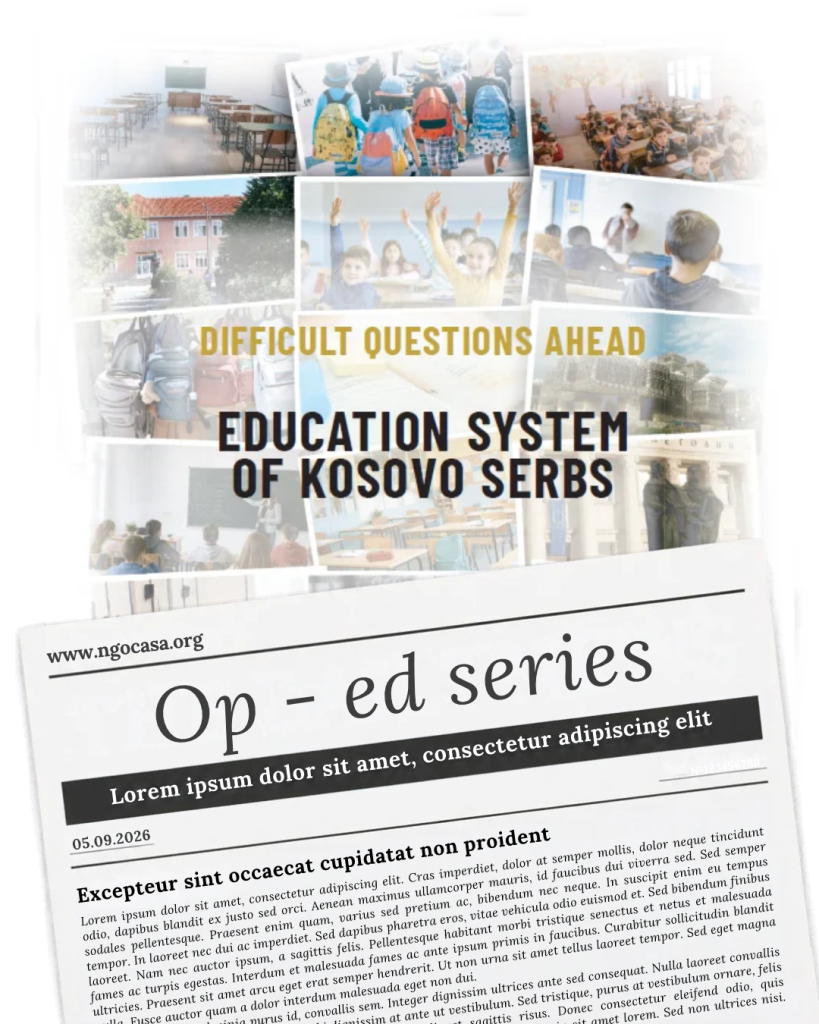
This op-ed is part of the research initiative “Difficult Questions Ahead: The Education System of Kosovo Serbs”, implemented by NGO CASA. The views and opinions expressed in this article are those of the author and do not necessarily reflect the views of NGO CASA or the donor supporting the research.