By: Miodrag Marinković
This text is an entirely personal response to the panic that has gripped the Serbian community in Kosovo in recent days over the status of education and healthcare institutions. I understand people; they have every reason to be concerned. Their children, their jobs and their lives are at stake. Serbian politicians—the very people who should be providing them with answers—remain silent or mislead them with platitudes and empty words behind which there is neither a clear idea nor a realistic plan. Official Belgrade is also shamefully, inexcusably silent, pushing this inconvenient issue aside at a time when it is fighting tooth and nail—and with police batons—for its own political survival. In doing so, it makes its priorities painfully clear: their seats of power.
Under such circumstances, Kosovo Serbs are understandably frightened and concerned, and they deserve at least some answers.
Amid this madness and pervasive sense of defeatism, I will try to set out what I know and what I am able to conclude. It is up to you to decide how useful you find it. These are the facts you should know:
- The only—absolutely the only—internationally validated plan addressing the status of the Serbian community’s healthcare and education systems in Kosovo is the plan known as the European Path to Normalisation of Relations, together with its derivative, the so-called Ohrid Agreement.
It envisages that the Serbian community will exercise its rights and access services within a “self-management framework”, better known to everyone as the Association/Community of Serb-Majority Municipalities.
- The draft statute of the Association/Community of Serb-Majority Municipalities, prepared by the European Union and submitted to the Kosovo Government for referral to the Constitutional Court, envisages education and healthcare being organised as privately operated service systems under the competence of the Association/Community.
What does this mean in practical terms for ordinary people? It means that these institutions would continue operating according to the curricula and programmes of the Ministry of Education of the Republic of Serbia and other relevant ministries; their employees would continue receiving salaries from the budget of the Republic of Serbia, through funds transferred via the Central Bank of Kosovo; while Kosovo legislation would recognise their operation by granting them the status of private institutions.
- In April 2024, ahead of the vote on Kosovo’s membership in the Council of Europe, the EU submitted precisely this draft statute to the Kosovo Government, requesting that it refer the document to the Constitutional Court for a review of its constitutionality. Albin Kurti rejected that request.
As a result, Kosovo was excluded from the vote on membership in that organisation.
- Kosovo’s outgoing government, as we all know, firmly rejects this draft and any discussion on the establishment of the Association/Community of Serb-Majority Municipalities. Nevertheless, this does not change the European Union’s position that this draft represents the framework for addressing the collective rights of the Serbian community, including the education and healthcare systems.
Albin Kurti’s government has therefore been under sanctions for some time, and these have intensified significantly in recent days following the suspension of the Strategic Dialogue by the United States and amid tacit but evident pressure on Kosovo’s opposition to form a new government and remove Kurti from office.
- The formation of a new opposition-led government in Kosovo is today not only mathematically possible but, following the severe measures imposed by the United States, has also become a politically realistic option.
Such a government is expected to be based on the principles of strategic cooperation with Western partners, the EU and the United States, which would, in all likelihood, mean the reactivation of negotiations on the Ohrid plan, the establishment of the Association/Community of Serb-Majority Municipalities, and the resolution of the status of education and healthcare institutions in the manner envisaged by the EU Draft Statute of the Association/Community.
Therefore, the issue of education and healthcare institutions has not been resolved, nor will it be resolved through unilateral actions by Albin Kurti, even though his government has been working toward that end for several years. This issue cannot be addressed according to the approach the Kosovo Government has followed so far—namely, with guns and police—because it is far too complex for solutions to be imposed in such a manner.
This is all the more the case because Kosovo’s legislation currently in force places the right of non-majority communities to education above any legal act that could jeopardise that right.
Albin Kurti has spent years looking for a legal basis to act unilaterally, but he has evidently not found one. Had he found it, he would already be closing schools and hospitals in Serbian communities.
The statements made by Minister Rašić, which have also triggered such panicked reactions within the Serbian community, should be viewed in this light. Arbitrary and speculative, they reflect more the style in which Kurti handles issues than any indication of a concrete plan.
Minister Rašić is therefore demonstrating that he has no intention of critically examining the actions of his superior, Albin Kurti, nor does he appear to consider this an obligation toward the people he represents.
Instead, through servile positions disguised as so-called “realpolitik”, he seeks to preserve his own position and the sinecures that come with it.
Fortunately, as things currently stand, this issue will be decided by neither Kurti nor Rašić.
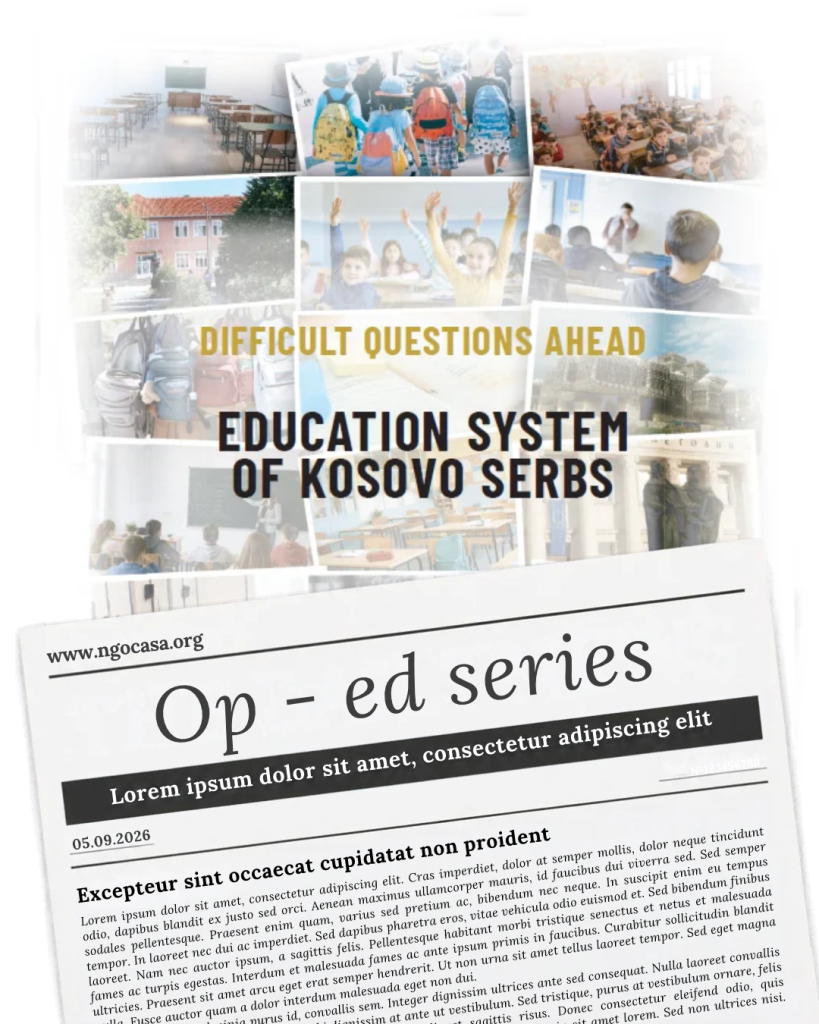
This op-ed is part of the research initiative “Difficult Questions Ahead: The Education System of Kosovo Serbs”, implemented by NGO CASA. The views and opinions expressed in this article are those of the author and do not necessarily reflect the views of NGO CASA or the donor supporting the research.