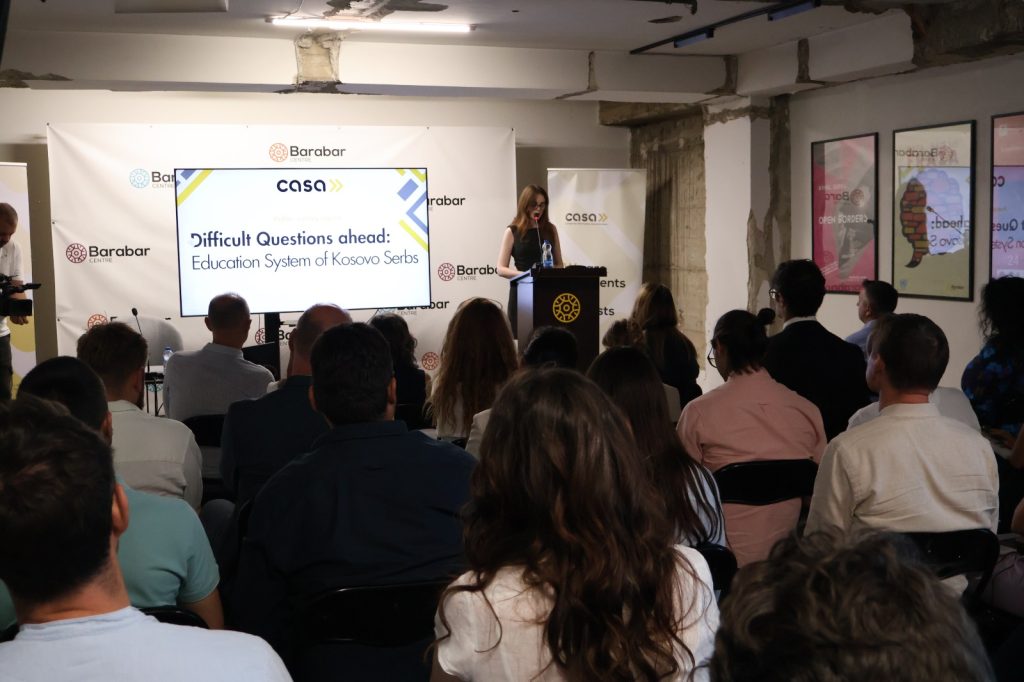
NGO CASA presented its new research paper, Difficult Questions Ahead: Education System of Kosovo Serbs, on 3 September 2026 at the Barabar Centre in Pristina. The conference gathered representatives of civil society, the international community, media, and other interested actors for a discussion on the current position and possible future status of the education system serving the Kosovo Serb community.
The research was initiated in early 2026, amid growing public discussion about the possible integration of Serbian educational institutions into the Kosovo education system. Rather than examining the issue from only one community perspective, the research was designed as a comparative analysis of Kosovo Serb and Kosovo Albanian views, identifying differences in how the two communities perceive the issue, as well as concerns and points of convergence that could provide a basis for substantive dialogue.
During the conference, the authors and contributors to the research presented findings from both parts of the study, covering Kosovo Albanian perspectives on the possible integration of Serbian language education and the views of the Kosovo Serb community on the existing system and potential changes to its status. The presentation also introduced CASA’s harmonized policy recommendations, developed by bringing the two perspectives together and identifying issues that any future institutional solution would need to address.
The paper combines analysis of the existing education system, relevant Kosovo legislation, agreements reached through the Belgrade Pristina Dialogue, and survey research examining the views of both the Kosovo Serb and Kosovo Albanian communities. It finds that the question cannot be reduced to a formal change of institutional status, as any such process would directly affect continuity of education, acquired rights, employment, qualifications, financing, and the functioning of an already established and interconnected education system.
Based on these findings and the two community perspectives, the recommendations call for any potential change to be approached as legal and institutional recognition rather than assimilation, with legal clarity, continuity of education, meaningful involvement of the Kosovo Serb community, and agreement through dialogue rather than unilateral measures.
The research and its public presentation were supported by Open Society Foundations Western Balkans (OSF Western Balkans). CASA’s policy and research work is also supported through institutional support from the Kosovar Civil Society Foundation (KCSF) programme EJA Kosovo, cofinanced by the Swiss Agency for Development and Cooperation (SDC) and Sweden.
The full research paper, including the findings and harmonized policy recommendations, is available HERE.